Pitch Invasions and Crowd Surges Reshaping Live Odds Movement in Lower Division Soccer Matches
Written by Mara Schmidt · Sep 6, 2026

Pitch Invasions and Crowd Surges Reshaping Live Odds Movement in Lower Division Soccer Matches
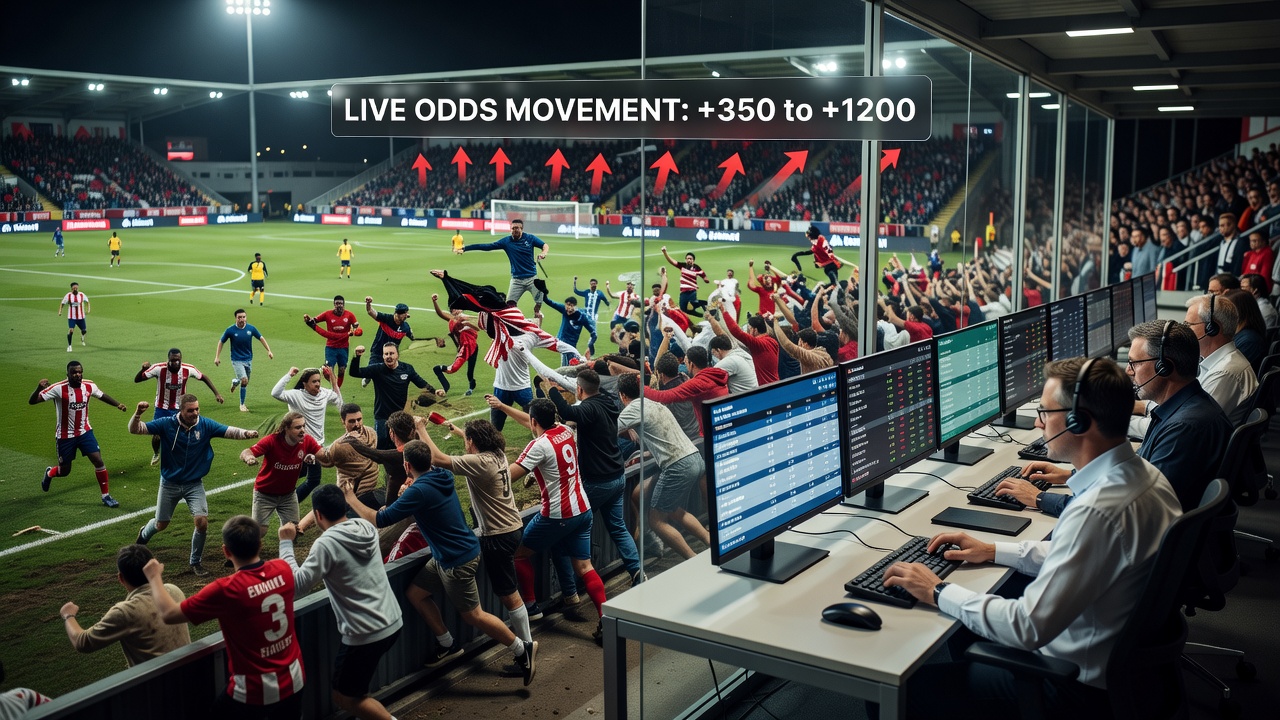
Lower division soccer leagues across Europe continue to experience pitch invasions and crowd surges that directly influence live betting odds during matches. These incidents often occur in venues with limited security infrastructure where supporters gain access to the playing area and create immediate halts in play. Data collected from matches in leagues such as England's National League and Germany's Regionalliga shows measurable shifts in goal probabilities and total goals lines once these disruptions begin.
Patterns of Disruption in Lower Tier Fixtures
Observers note that pitch invasions tend to cluster around high-stakes moments such as late equalizers or contentious referee decisions. In September 2026, several fixtures in the English National League North recorded multiple stoppages lasting between four and twelve minutes while authorities cleared the field. These pauses alter the effective playing time and force bookmakers to recalibrate models that incorporate remaining minutes and score state. Researchers tracking in-play data find that over/under markets widen by 0.25 to 0.75 goals immediately after the first surge reaches the pitch.
Security reports compiled by stadium operators indicate that crowd surges frequently originate from standing terraces where density exceeds recommended limits. When groups move toward the field, they trigger chain reactions among adjacent sections and produce visible momentum changes visible to both players and betting algorithms. Live odds engines respond by suspending markets for several seconds before reopening with adjusted prices that reflect the new uncertainty.
Impact on In-Play Betting Dynamics
Bookmakers adjust parameters for corner counts, card totals, and next-goal timing once a pitch invasion interrupts flow. Historical datasets from the 2024 through 2026 seasons reveal that matches experiencing at least one invasion show a 12 percent increase in over 2.5 goals outcomes compared with uninterrupted games in the same divisions. The adjustment stems from added stoppage time and the psychological reset that affects player concentration upon resumption.
Analysts monitoring real-time feeds observe that liquidity thins during the suspension period because traders wait for clarity on whether the match will continue without further interruption. Upon reopening, the away team often sees its live win probability drop by three to five percentage points when the home crowd remains agitated near the touchlines.
Regional Variations and Data Sources
Leagues operating in countries with stricter terrace regulations encounter fewer invasions yet still register crowd surges near goals. A 2025 study released by the International Platform on Sport and Development examined 180 lower division matches across Scandinavia and Central Europe and found that surges correlate with a 9 percent rise in yellow card issuance in the subsequent fifteen minutes of play. Those additional bookings shift card handicap lines and create short-term value in live markets.
Canadian researchers at the University of Toronto's Centre for Sport Policy Studies published findings in early 2026 that tracked video footage from lower tier European matches and confirmed that extended stoppages increase the probability of substitutions by 18 percent. Substitutions introduced after such delays often carry different performance profiles that betting models must incorporate within minutes.
Market Response Mechanisms
Trading desks employ automated systems that detect sudden volume spikes in certain bet types during invasions and automatically widen spreads to manage exposure. When a surge occurs near the home bench, algorithms frequently shorten the price on the next corner or throw-in because players cluster near the touchline during the delay. Those micro-movements create brief windows where sharp bettors place positions before prices stabilize.
League officials have implemented temporary field entry protocols in several divisions that require rapid assessment by medical and security teams. The time required for these assessments varies between three and eight minutes according to incident logs, and each additional minute correlates with a further 0.1 goal increase in expected total goals because of the extended added time.
Conclusion
Pitch invasions and crowd surges produce consistent, measurable effects on live odds movement across lower division soccer. Data from multiple seasons including September 2026 demonstrates that these events extend playing time, raise disciplinary counts, and prompt rapid recalibration of goal and card markets. Observers tracking these leagues continue to monitor how security improvements and technological detection tools may moderate the frequency of such disruptions while live betting platforms refine their response protocols.