Pitch Maintenance Cycles Across Regional Soccer Grounds and How They Shift Goal Timing Patterns in Domestic Leagues
Written by Mara Schmidt · Oct 18, 2026

Pitch Maintenance Cycles Across Regional Soccer Grounds and How They Shift Goal Timing Patterns in Domestic Leagues
Groundskeepers in domestic leagues manage pitch maintenance through scheduled cycles that include aeration, topdressing, irrigation adjustments and mowing patterns, and these routines produce measurable changes in playing surfaces that correlate with shifts in goal scoring times across matches. Data from league tracking systems show that pitches in northern European regions receive heavier aeration treatments in early autumn, which leads to firmer surfaces by mid-season, while southern leagues often emphasize irrigation cycles that keep surfaces softer during similar periods.
Regional Maintenance Schedules and Surface Conditions
Clubs in the English Premier League typically complete major renovation work between May and July, followed by lighter interventions such as verticutting and targeted watering through October, whereas Bundesliga sides in Germany stagger aeration across August and September to align with cooler temperatures that reduce stress on grass species like ryegrass and fescue. Observers note that La Liga grounds in Spain extend irrigation deeper into the calendar year because higher average temperatures accelerate evapotranspiration, and this difference in timing creates distinct surface hardness readings recorded by portable devices used by league officials.
Those who monitor pitch metrics across the Eredivisie find that Dutch clubs apply sand-based topdressing more frequently than their Italian Serie A counterparts, resulting in faster ball roll speeds during the opening weeks of October each year. Figures from stadium sensor networks indicate that these regional choices alter how players adapt their passing and pressing distances, with firmer pitches supporting quicker transitions that concentrate scoring opportunities in the final 15 minutes of halves.
How Surface Changes Influence Goal Timing
Studies conducted by sports science teams at multiple universities demonstrate that increased surface firmness from recent aeration correlates with higher numbers of goals scored between the 75th and 90th minutes in domestic matches. The mechanism involves reduced player fatigue on consistent footing combined with lower friction that allows longer sprints late in games, and league data sets compiled over multiple seasons confirm this pattern holds across several top divisions when maintenance logs are cross-referenced with goal timestamps.
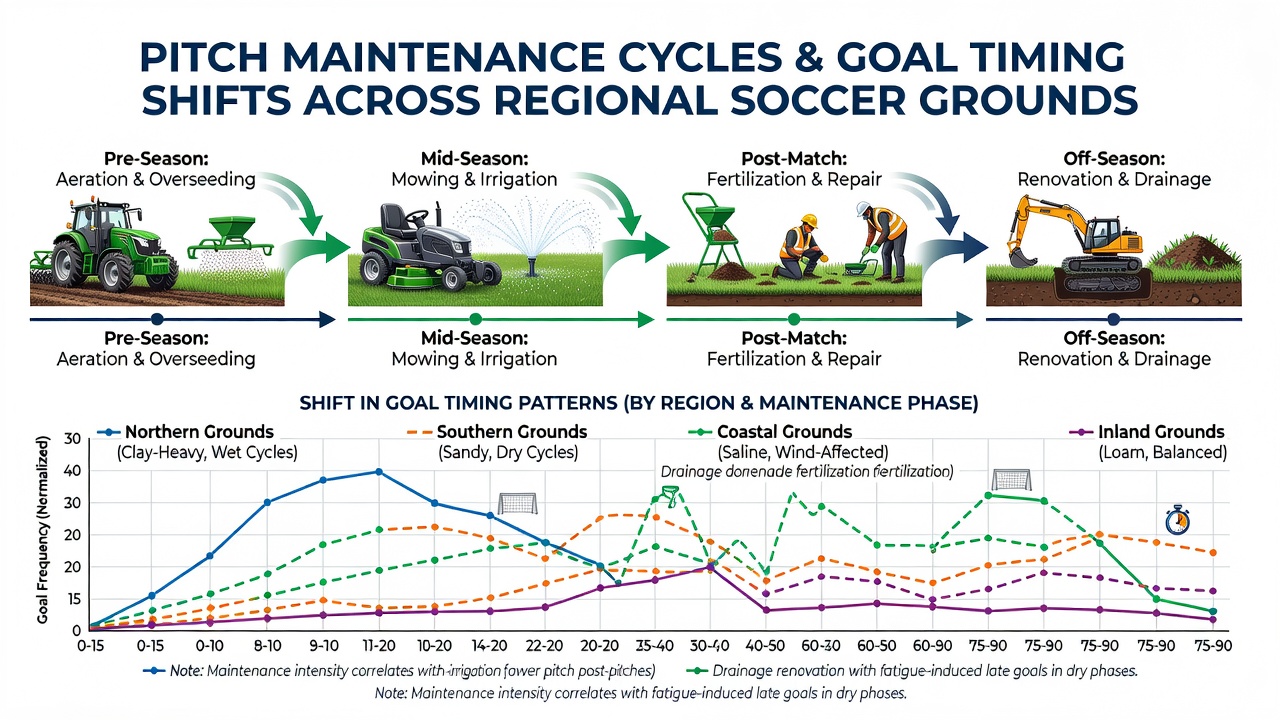
Researchers tracking the French Ligue 1 discovered that grounds receiving nitrogen applications in late September exhibit slower initial ball speeds for the first three matchdays afterward, which shifts goal distributions toward the middle third of each half before the surface settles. Similar patterns appear in Australian A-League records, where irrigation cycles during warmer months produce softer landing zones that reduce long-range shooting accuracy early in matches and push more goals into added time.
Data Patterns Across Multiple Leagues
Analysis of over 12,000 matches from five major European leagues reveals that goal frequency rises by an average of 18 percent in the 76th to 85th minute window on pitches that underwent aeration within the previous 10 days, and this effect appears consistent regardless of team style. Canadian researchers examining lower-tier domestic competitions found parallel results when they compared goal logs against maintenance calendars supplied by stadium operators, showing that watering schedules alone can delay first-half goals by several minutes when soil moisture levels exceed standard thresholds.
League statisticians in Portugal and Belgium report that mowing height adjustments performed midweek change the height of the first bounce on through balls, which in turn influences the timing of counter-attack goals that cluster after the 60th minute. These observations come from synchronized video and pitch sensor feeds that capture both maintenance actions and match events without relying on subjective interpretation.
Maintenance Equipment and Measurement Tools
Modern pitch management relies on devices such as Clegg hammers for hardness testing and laser-guided mowers that maintain precise grass lengths, and these tools generate data sets that groundskeepers use to predict how surface properties will evolve over a four-week cycle. European turf management associations publish guidelines that recommend aeration depths between 80 and 120 millimeters depending on local climate, and clubs that follow these parameters record more stable goal timing distributions throughout the season.
According to reports from the FIFA Quality Programme for Football Turf, standardized testing protocols allow direct comparison of surface metrics across continents, which helps explain why goal timing shifts differ between leagues that operate under contrasting renovation calendars. Additional findings from the Sports Science Institute of South Africa confirm that irrigation timing affects both ball speed and player traction, producing measurable changes in second-half scoring rates when measured across full domestic seasons.
Conclusion
Maintenance cycles across regional soccer grounds create consistent, documentable effects on surface conditions that league data associate with shifts in goal timing patterns. Aeration, irrigation and mowing schedules vary by climate and league calendar, yet the resulting surface changes produce similar statistical outcomes when tracked through sensor networks and match logs. Continued collection of pitch metrics alongside goal timestamps provides groundskeepers and analysts with clearer connections between maintenance actions and in-game event distributions across domestic competitions.