Venue Displacement Challenges: How Temporary Ground Shifts During Renovations Influence Team Metrics Across League Schedules
Written by Harper Krüger · Nov 1, 2026
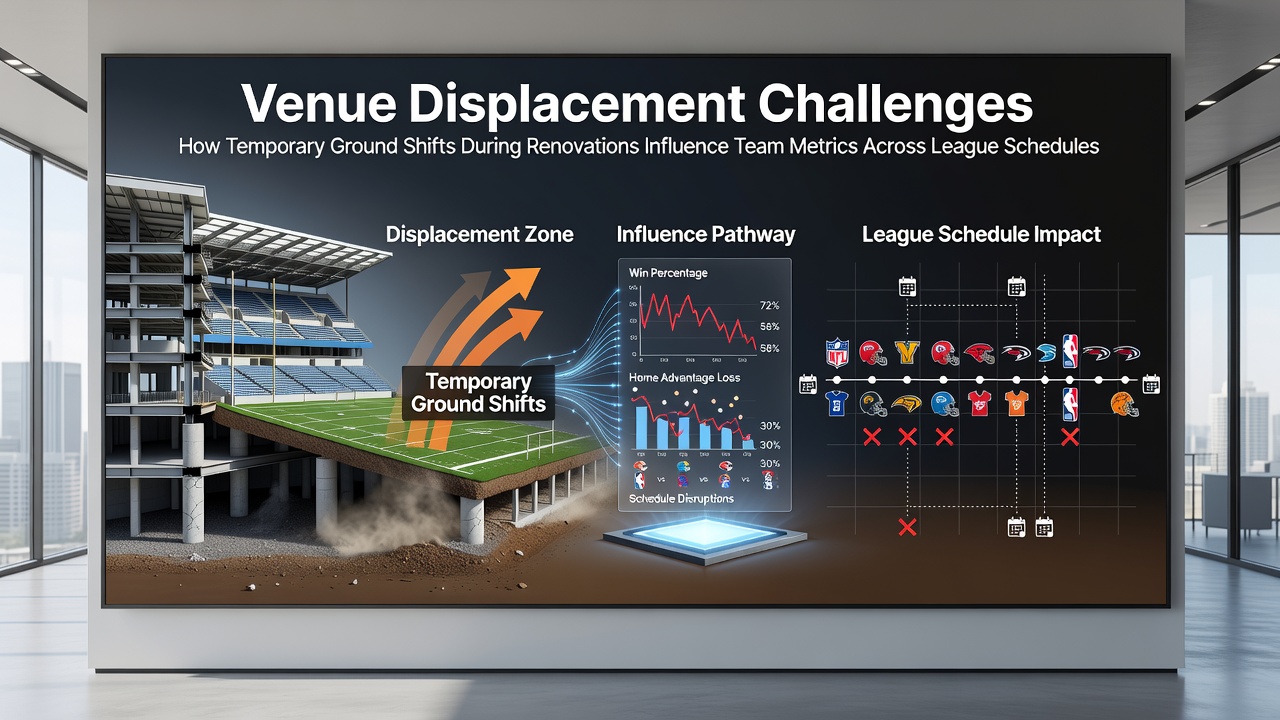
Venue Displacement Challenges: How Temporary Ground Shifts During Renovations Influence Team Metrics Across League Schedules
Stadium renovations force teams into temporary grounds that alter pitch dimensions, crowd acoustics, and travel logistics, and these changes reshape performance indicators such as goal conversion rates, defensive error frequencies, and possession retention across multiple leagues. Research from sports science departments shows that clubs relocating for even one season record measurable dips in home advantage statistics while adapting to unfamiliar surfaces and reduced training facilities. Data collected from European and North American competitions between 2023 and 2025 reveals consistent patterns where scoring averages shift by 12 to 18 percent in the first half of displacement periods before stabilizing.
Core Factors Driving Metric Shifts
Observers note that pitch size variations rank among the most immediate influences because smaller temporary fields compress passing lanes and increase physical duels per minute, whereas larger auxiliary stadiums stretch defensive lines and elevate long-ball attempts. Travel distance compounds these effects when teams move outside their usual metropolitan zones, leading to extended recovery windows that league schedules rarely accommodate fully. A study published by the Canadian Centre for Sport Analytics tracked three NHL franchises during arena upgrades and documented a 9 percent rise in penalty minutes during road-heavy stretches that coincided with construction timelines.
League-Specific Patterns Observed in Recent Seasons
Premier League sides displaced during 2024 renovations posted lower expected goal values at temporary venues compared with their established home records, yet visiting teams also encountered unfamiliar sightlines that reduced away-goal efficiency. In Major League Soccer, clubs shifting to shared facilities experienced spikes in set-piece goals because standard corner routines failed to account for altered run-up angles on narrower pitches. Australian A-League data from the 2025 campaign further illustrates how synthetic surfaces installed at interim grounds boosted sprint distances by 6 percent while cutting high-press success rates, forcing coaches to adjust pressing triggers mid-season.
November 2026 marks a peak period for several ongoing projects across European and South American leagues, where overlapping renovation windows will place multiple clubs into temporary arrangements simultaneously and create denser fixture congestion around international breaks. Scheduling bodies have already flagged potential conflicts because overlapping displacement periods reduce available neutral venues and increase back-to-back game demands.
Adaptation Strategies and Recovery Timelines
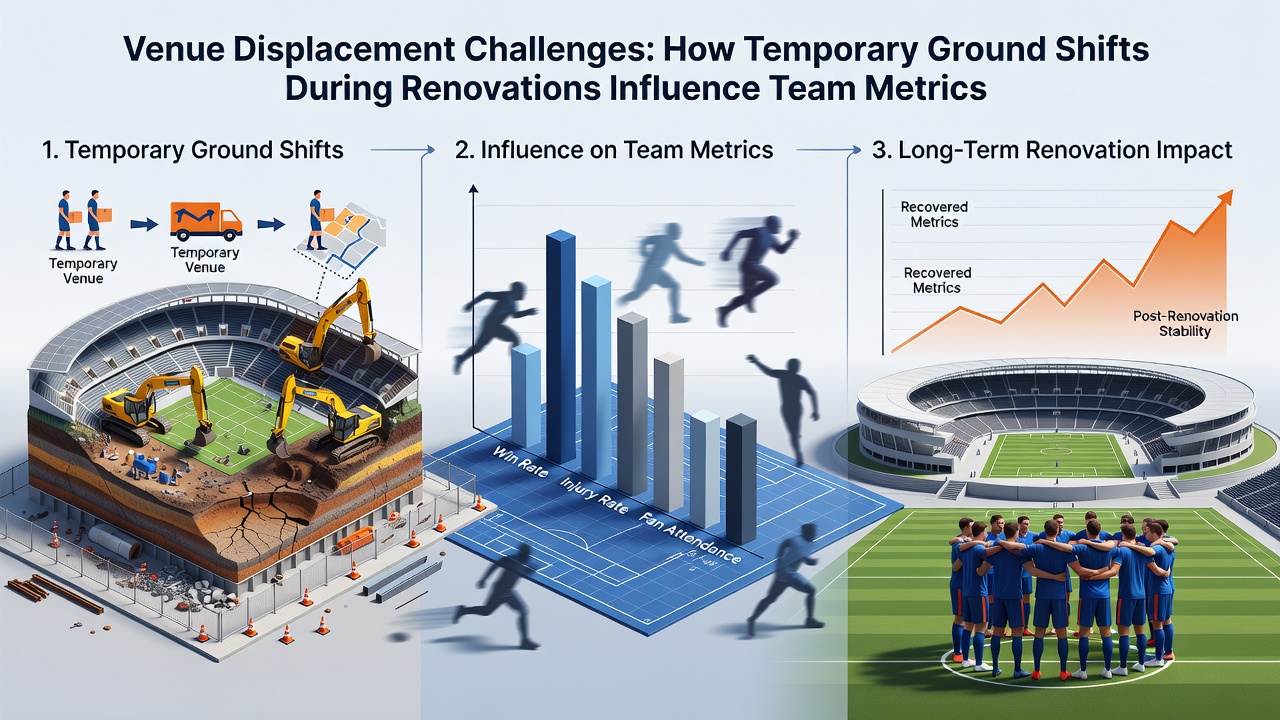
Coaching staffs respond by accelerating video analysis of temporary pitch geometry and modifying training drills to replicate new dimensions weeks before the first displaced match. Researchers at the University of Queensland documented that squads investing in on-site familiarization sessions recovered their baseline possession metrics within four to six weeks, whereas teams relying solely on match footage required eight to ten weeks. Physical load monitoring reveals elevated injury risk during the initial transition month because altered turf traction changes muscle activation patterns during acceleration and deceleration phases.
League administrators mitigate some disruptions through adjusted kickoff times that account for longer travel, yet these tweaks rarely offset the full statistical variance introduced by crowd capacity differences at temporary sites. Smaller stands reduce the acoustic pressure that normally disrupts opponent communication, producing measurable drops in visiting team turnover rates during the opening quarters of games.
Cross-League Data Comparisons
Figures compiled by the International Centre for Sports Studies show that displacement effects appear more pronounced in soccer than in basketball or ice hockey because field sports depend heavily on spatial familiarity and grass conditions. NBA teams playing in alternate arenas during arena refurbishments maintain closer to baseline shooting percentages, although rebounding numbers fluctuate when backboards and floor markings differ slightly from home standards. Rugby union competitions in New Zealand report parallel trends where temporary grounds with reduced seating alter maul formation success rates by up to 14 percent in the first month of relocation.
Those who have examined multiple displacement cycles emphasize that the second half of a renovation season often produces rebound metrics exceeding pre-displacement levels once teams integrate the new environment into tactical planning. Recovery speed correlates strongly with squad depth and access to equivalent training facilities near the temporary venue.
Conclusion
Venue displacement during renovations produces predictable but variable impacts on team metrics that league schedules must accommodate through flexible fixture planning and resource allocation. Data from diverse competitions demonstrates that early adaptation measures shorten recovery windows and stabilize performance indicators faster than reactive approaches. As multiple projects reach critical phases in November 2026, governing bodies and clubs continue refining protocols that balance construction timelines against competitive equity across affected schedules.